Iodine has been used clinically as an antiseptic for over 170 years. What has changed is the means of delivery. The Passive Molecular Iodine Inhaler draws pharmaceutical-grade PVPI solution through a precision chamber, liberating molecular iodine (I₂) vapor into each breath — quietly, continuously, and without aerosols or sprays.
Think of the clean, mineral-sharp air of the seashore. The effect here is similar in mechanism — iodine-laden air drawn naturally into the lungs — but deliberately controlled and precisely formulated.
How to Use
Simple. Measured. Consistent.
The inhaler requires no electricity, no app, and no special technique. Breathe normally through the mouthpiece. The physics does the rest.
When you breathe through the Inhaler, the molecular iodine vapor is carried into the airways and lungs and, like other inhaled gases, is absorbed into the bloodstream — much as iodine-bearing air is absorbed when breathed at the seashore. The amounts involved are modest, carefully calibrated by the PVPI concentration of the refill solution.
Because the deliberate, repeated inhalation of iodine vapor has not been formally studied in humans in controlled clinical trials, we are transparent about this and recommend the cautions noted below.
1
Fill
Add your refill solution (1% PVPI pharmaceutical grade) to the glass reservoir to the marked fill line.
2
Seal & Hold
Replace the steel cap and mouthpiece. The sealed glass chamber preserves vapor concentration between sessions.
3
Breathe
Breathe slowly and naturally through the mouthpiece for the recommended session duration — typically 3–5 minutes, 1–2 times daily.
4
Refill as Needed
Replace refill solution when the reservoir reads low or at the interval specified in your instructions. Each refill bottle supports multiple sessions.
Absorption & Physiology
What happens when you breathe it in?
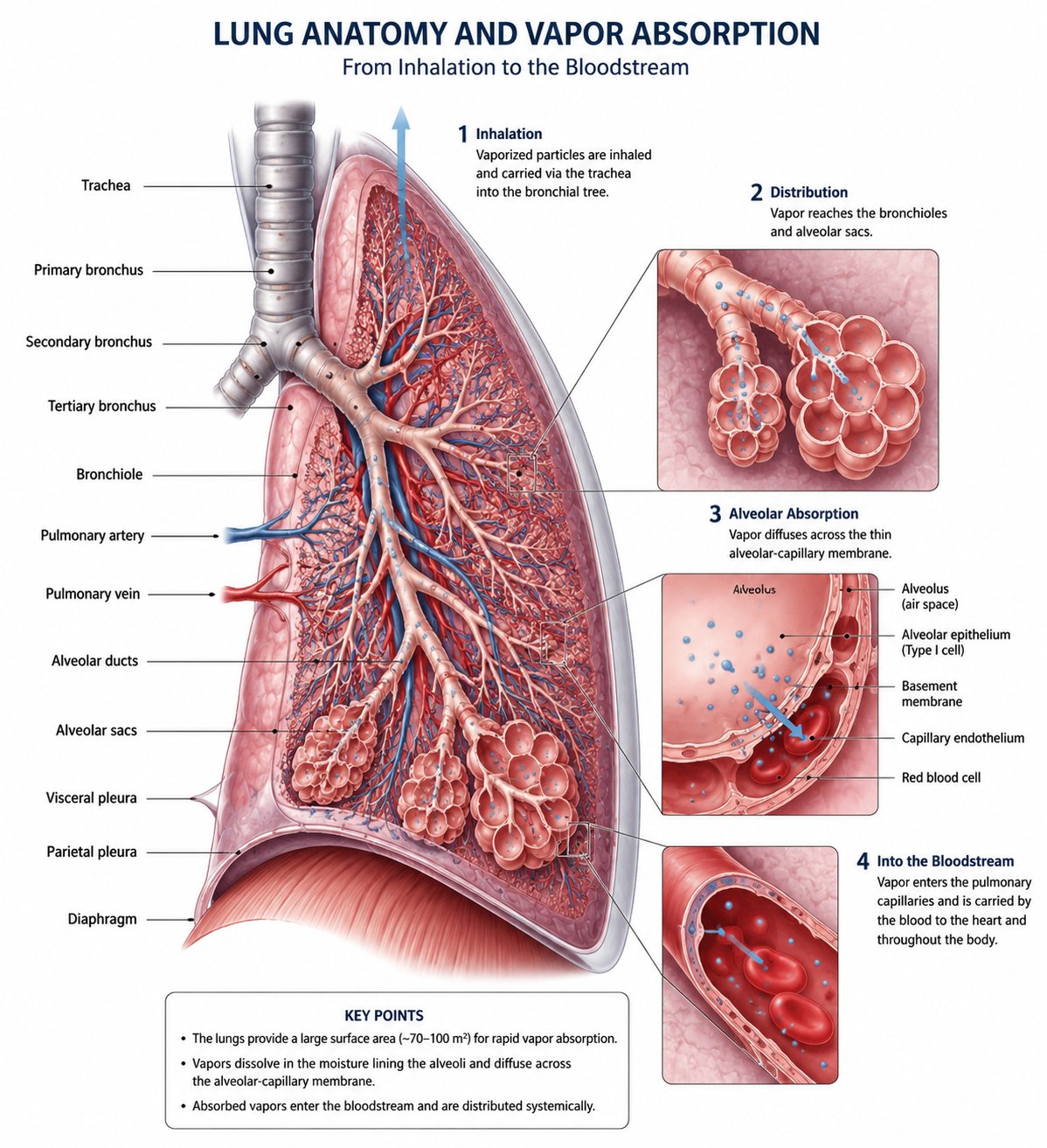
Molecular iodine (I₂) is a small, lipophilic gas that behaves in the airways much as other inhaled gases do. Inhaled vapor is carried past the upper airway, into the bronchi, and ultimately into the alveoli — the deep lung surfaces where gas exchange occurs. There, as with oxygen and other inhaled gases, molecular iodine crosses the alveolar-capillary membrane and enters the systemic circulation.
This is not speculative. Iodine's absorption kinetics from inhalation have been documented in isotope-tracer and occupational-exposure research. What is borrowed from that literature is the mechanism: the vapor is retained and cleared from the respiratory tract with a half-time measured in minutes — consistent with rapid systemic absorption rather than local deposition alone.
"There are no systematic studies on health effects of inhalation of iodine vapor in humans."
— Ludwig et al., occupational exposure literature (frequently cited in iodine inhalation research)
The four stages of vapor absorption — from inhalation through the trachea to systemic entry via the pulmonary capillaries.
We cite that statement not to alarm, but to be precise. The absorption pathway is well-characterized. The chronic safety of deliberate repeated inhalation at the doses this device delivers has not been the subject of a formal human clinical trial. We believe the analogy to iodine-rich sea air is apt and the amounts modest; we also believe honest transparency serves our customers better than overclaiming.
The iodine you take in via this device ultimately adds to your body's total iodine pool — a pool that, according to NHANES urinary iodine data, has declined substantially in the American population since the 1970s due to shifts in diet and agricultural practice.
Who Should Take Caution
Persons with known thyroid conditions (hypo- or hyperthyroidism, Hashimoto's, Graves' disease) — consult your physician before use.
Persons with documented iodine sensitivity or allergy.
Pregnant or breastfeeding women — iodine requirements change significantly; consult your obstetrician.
Children under 12 — consult a pediatrician before use.
The Clinical Hypothesis Behind This Device
Built on a surgeon's fifty years of insight.
This inhaler was not designed by marketers. It was built in direct response to a published clinical hypothesis by Dr. Raj K. Gandhi, a thoracic surgeon with more than fifty years of operative experience — including decades of applying povidone-iodine to cut pulmonary and pleural surfaces during surgery.
Dr. Gandhi's insight was straightforward: if surgeons have safely applied dilute PVPI directly to living lung tissue for generations, the question worth asking is whether molecular iodine vapor — inhaled through a very dilute solution — might travel through the airways and enter the systemic circulation in amounts sufficient to be biologically meaningful against respiratory pathogens.
In his 2021 paper in the Journal of Medical Research and Innovation, Dr. Gandhi laid out the biological rationale, estimated the dose range, and reported a brief personal self-experiment monitoring oxygen saturation and heart rate. He was careful to call what he had written what it is: a hypothesis we must test. He did not claim proof. He called for the human studies that would provide it.
We built this device to make his proposed therapy available for exploration — and to do so honestly. We name him, we cite his paper, and we use his own language: this is a clinically reasoned hypothesis, advanced by a surgeon of considerable standing, that merits investigation. Users of this inhaler are, in a meaningful sense, participants in that investigation.
Each inhaler is hand-assembled using borosilicate glass and surgical-grade steel. Refill solutions are pharmaceutical-grade PVPI prepared to specification.
The Device
Passive Molecular Iodine Inhaler
$250
Borosilicate glass reservoir, surgical steel housing, mouthpiece, instructions, and first refill solution included.
Glass & steel construction — no plastic contact surfaces
Includes initial 1% PVPI pharmaceutical-grade refill
Iodine Products, Inc. was founded in South Miami, Florida by Eugene Rosov, whose work in iodine research and product development spans four decades. The company's mission is straightforward: to make pharmaceutical-grade iodine formulations accessible, affordable, and honestly explained — to everyone who needs them.
That mission grew from a conviction most of mainstream medicine has been slow to share: that the dramatic, documented decline in population iodine sufficiency since the 1970s — confirmed in the NHANES urinary iodine surveys — has had real, underappreciated consequences for human health. NHANES data show median urinary iodine levels have fallen by roughly 50% in American adults since 1971. Iodine does not merely support thyroid function; it is involved in immune signaling, breast tissue health, cognitive development, and mucosal defense.
The Passive Molecular Iodine Inhaler represents the newest and most technically demanding product in the Iodine Products line — designed to bring iodine directly to the lower respiratory tract by the most physiologically natural route available: breathing.
Our regulatory position is clear: none of our products are drugs. None make disease claims. They are devices and supplements offered to an adult public that deserves honest information and the freedom to make its own choices.
50%
Decline in U.S. Population Iodine Levels
NHANES urinary iodine surveys document a roughly 50% fall in median iodine levels in American adults between 1971 and the 2000s — a shift with broad, underappreciated health implications.
170+
Years of Clinical Iodine Use
Iodine has been in continuous clinical use as an antiseptic since the mid-19th century — one of medicine's oldest and most studied antimicrobial agents.
11
Iodine Products Websites & Formulations
From oral and nasal sprays to ophthalmic solutions, supplemental iodine drops, topical soaps, and the inhaler — a complete iodine product family built over forty years.
305 667-9375
Direct Line — Always Answered
Questions about any product are answered directly. No automated systems. No hold queues. Call or email erosov@iodineproducts.com.
A Resource
Respiratory Parasites: What Medicine Rarely Teaches.
The lower respiratory tract is not sterile, and it is not immune to parasitic infection. Yet in the United States, the topic of pulmonary parasitology receives almost no attention in medical education — even among pulmonologists. Patients with chronic, unexplained respiratory symptoms are often cycled through courses of antibiotics, corticosteroids, and allergy workups without a single parasitic etiology considered.
This page is offered purely as an educational resource. It is not a diagnostic tool and does not imply that the Passive Molecular Iodine Inhaler treats, cures, or prevents any parasitic infection. If you suspect a parasitic lung infection, you need a physician — ideally one with infectious disease or tropical medicine training.
The organisms below represent the most clinically significant lower respiratory tract parasites with global or significant North American prevalence. They are worth knowing about.
Picture the same patient seen by two different physicians — a chronic cough that won't resolve, a throat that's always a little phlegmy, perhaps some wheeze. A pulmonologist practicing in much of Central or South America will, almost reflexively, keep parasitic infection somewhere on the list of possibilities, and may order a microscopic stool examination to rule it in or out. A pulmonologist practicing in the United States is vanishingly unlikely to think this way at all. The organisms are simply not on the mental map.
That difference is not about skill. It is about prior probability — what a physician expects to find based on where their patients live. And it leaves a real gap, because a meaningful number of people, wherever they live now, may carry organisms acquired elsewhere. When the possibility is never raised, parasitic disease in the lung is occasionally misread as something else entirely — including tuberculosis or malignancy.
Passing Through, or Settling In
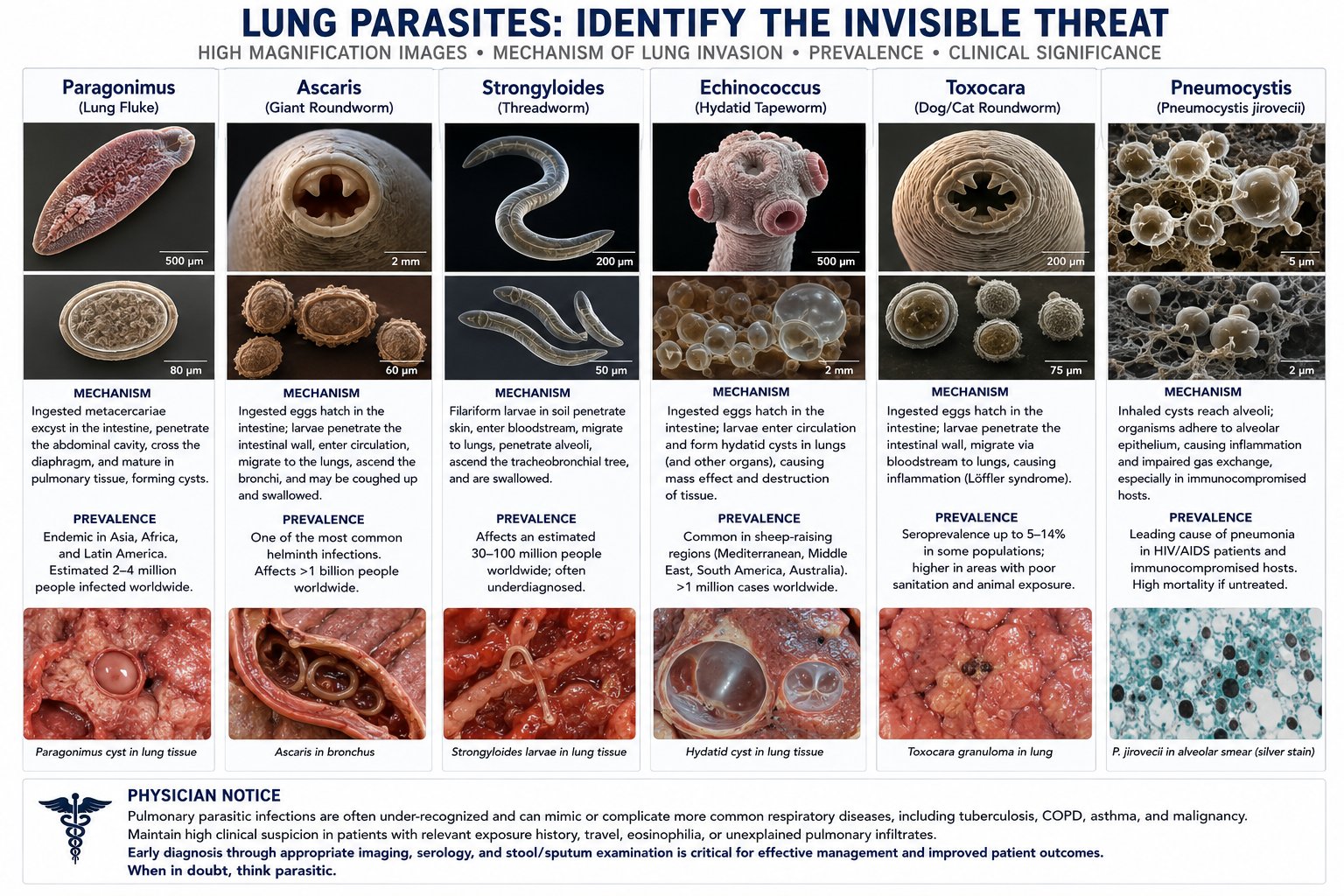
Most of these infections begin in the gut or skin, not the lung. But several common ones travel through the lungs as part of their life cycle — entering the bloodstream, crossing lung tissue, climbing the airway, and being swallowed back down. During that passage they can cause cough, wheeze, asthma-like symptoms, or fleeting patches on a chest film. A smaller group can take up long-term residence and form chronic lesions — and those are the ones most often mistaken for other diseases.
Transient migration
Ascaris
Larvae travel through the liver and lungs before returning to the gut; symptoms may appear during that migratory phase.
Transient, may recur
Strongyloides
Enters through the skin and passes through the lungs. In people with weakened immunity, it can cause far more serious, recurrent lung disease.
Transient migration
Hookworm
Follows a lung-migration pattern similar to Ascaris, with transient respiratory symptoms along the way.
Variable migration
Toxocara
Humans are accidental hosts; larvae wander through tissue, sometimes the lung, and can provoke eosinophilic inflammation.
Chronic / permanent
Paragonimus
A true lung fluke. Adults can live for years in lung tissue, producing cysts, scarring, and coughing of blood — with imaging that can closely resemble tuberculosis or a tumor.
Chronic / permanent
Echinococcus
Forms hydatid cysts that may sit in the lung for years, sometimes large enough to press on airways or rupture.
One note in the interest of accuracy: you may see Pneumocystis jirovecii listed alongside these. It is now classified as a fungus rather than a parasite. It lives in the air sacs and causes severe pneumonia, chiefly in people with significantly weakened immune systems. We mention it for completeness and to be precise about the distinction.
When Might This Be Worth a Question?
None of this means you have a parasite. Most coughs are ordinary, and most of these infections are intestinal rather than pulmonary. But the following pattern, taken together, is the kind of thing reasonable to raise with a physician — ideally one who keeps these possibilities in mind:
A chronic cough that hasn't resolved as expected · a persistently phlegmy throat or recurrent unexplained bronchitis · asthma-like symptoms without a clear cause · repeated or shifting patches on chest imaging, or pneumonia that won't fully clear · coughing up blood · an elevated eosinophil count on bloodwork · time spent in Central America, South America, or other regions where these infections are more common.
The reasonable thought is not “I must have this.” It is: “Chronic cough, some travel history, a throat that's always a little phlegmy — I wonder. Maybe I should find a pulmonologist who would wonder too.” That single question, asked of the right person, is the entire purpose of this page.
A note for physicians and patients alike: The organisms above are not exotic curiosities. Several have significant North American prevalence and are routinely missed because they are not on the differential. Any patient with chronic unexplained cough, eosinophilia, or recurring pulmonary infiltrates — particularly with a history of international travel, immunosuppression, or exposure to animals — deserves a parasitic workup. The resources of the CDC Division of Parasitic Diseases and the American Society of Tropical Medicine and Hygiene are the appropriate starting points.
Iodine Products, Inc.
Our Other Products & Websites
A complete family of pharmaceutical-grade iodine formulations — each with its own dedicated website, each developed over decades of research and clinical attention.
The Passive Molecular Iodine Inhaler is sold as a device for the inhalation of pharmaceutical-grade molecular iodine vapor. It is not a drug. It has not been evaluated by the Food and Drug Administration for the diagnosis, treatment, cure, or prevention of any disease or condition. The clinical hypothesis underlying its design — that inhaled molecular iodine vapor may have systemic antimicrobial effects — remains an investigational hypothesis and has not been validated in controlled human clinical trials.
Iodine is an essential mineral. Iodine sufficiency varies widely in the modern population. Users with pre-existing thyroid conditions, iodine sensitivity, or who are pregnant or breastfeeding should consult a qualified physician before use.